
June 2017
Brand as Discipline

In 2015 I left an industrial design agency in downtown San Francisco to take an in-house job at a fintech company most people in the agency world hadn't heard of. The agency partners thought I was making a mistake. Tech was the place people went when they couldn't hack it in design: free lunch, stock options, and unlimited PTO. That's not real work.
I went anyway. The agency was good and I'd learned a lot there, but the tech companies I rode past on my way to and from the studio every day were doing something different. The adjacency wasn't enough. Tech was starting to take design seriously and I wanted to contribute to that, not watch it from across the street.

Race-bred commuter on Gold Street, downtown San Francisco.
NerdWallet was founded in 2009 by Tim Chen and Jacob Gibson in a spreadsheet. In 2008 Chen was laid off from his hedge fund job and his sister asked him for help picking a credit card. He spent a week comparing offers in Excel to share with her, and realized that the same opacity applied to nearly every personal finance decision. By the time I joined, they had grown on SEO and content alone: no brand work, no advertising spend, no paid user acquisition. They needed someone who understood all three.
The first work was classic brand identity: a new logo, a new wordmark, a content production and design system that could carry the company out of a category where it had previously competed on SEO and into one where it would compete on recognition. NerdWallet had been a brand only in the sense that any product with a name is a brand. The exercise was to make it one in every other sense.
NerdWallet was product-and-data-first, like most tech companies of that moment. The argument I had to make was that brand was a discipline rather than a department, and that it belonged in the operating logic of the company rather than as a downstream service. The structural version of that argument was an in-house creative function that sat between Marketing and Product rather than reporting into either. Most in-house creative I'd observed from the agency side was either a marketing services function (briefs in, deliverables out, no strategic standing), or a product design team asked to also do marketing (category error). Sitting between the two meant the work could be strategized, written, and executed with equal fiduciary responsibility across departments. This isn't a new idea, but it's not often successful in Silicon Valley.
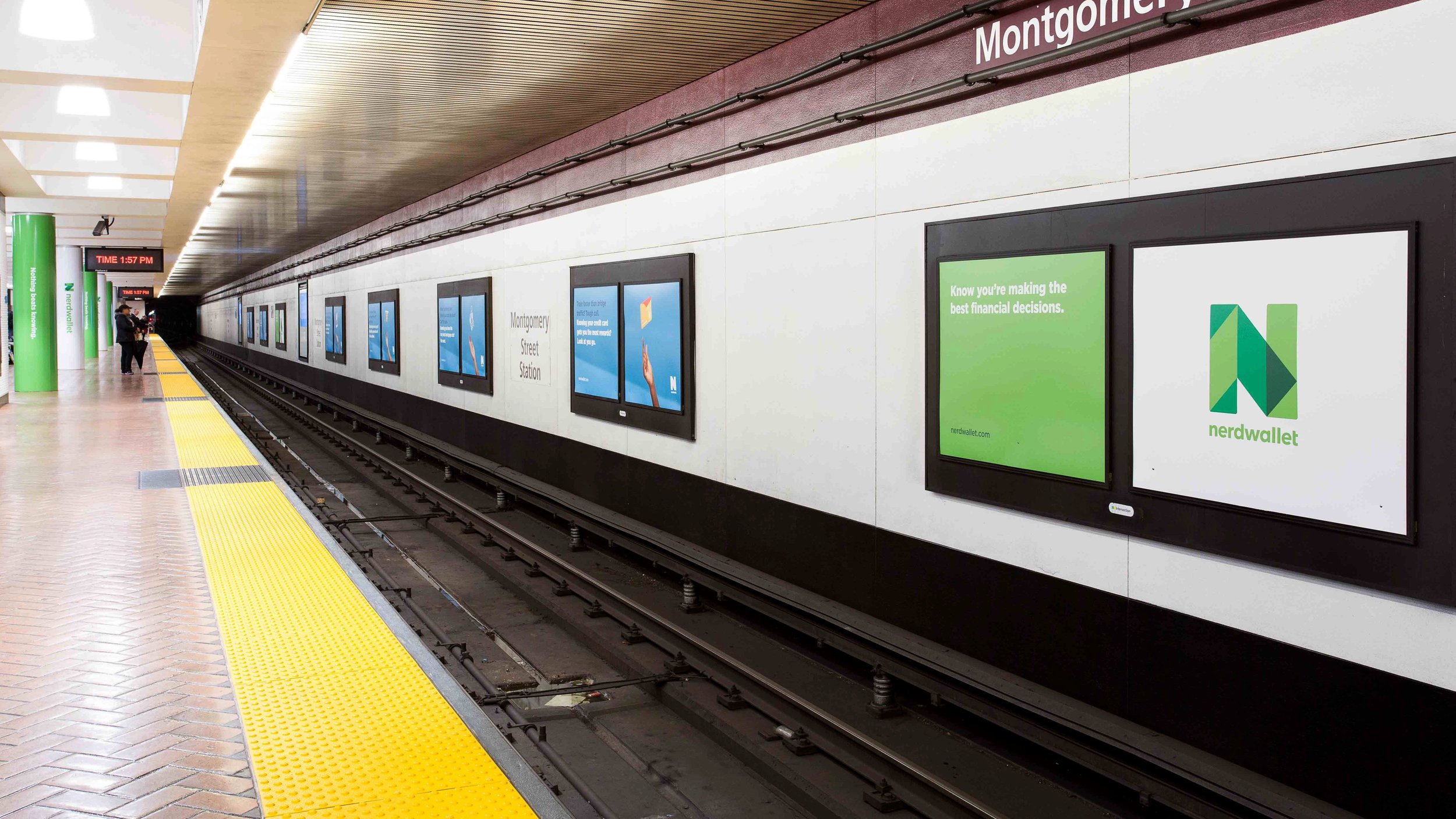
The campaign work layered on next. NerdWallet's first paid national integrated campaign—TV, online video, digital, radio, and local out-of-home—went out for the relaunch of the brand. We took over Embarcadero, Montgomery, and Powell BART stations: billboards, column wraps, every placement. Tech workers in downtown San Francisco passed it on the way to other startups that were defining the moment. The buyout ran for months. It was a statement to the industry NerdWallet was operating in. The company was no longer a finance comparison site. It was a brand.
Company: NerdWallet
Role: Principal Brand Designer
Years: 2015-2017
Finance: November 2021 IPO (NRDS)